
 GET A QUOTE

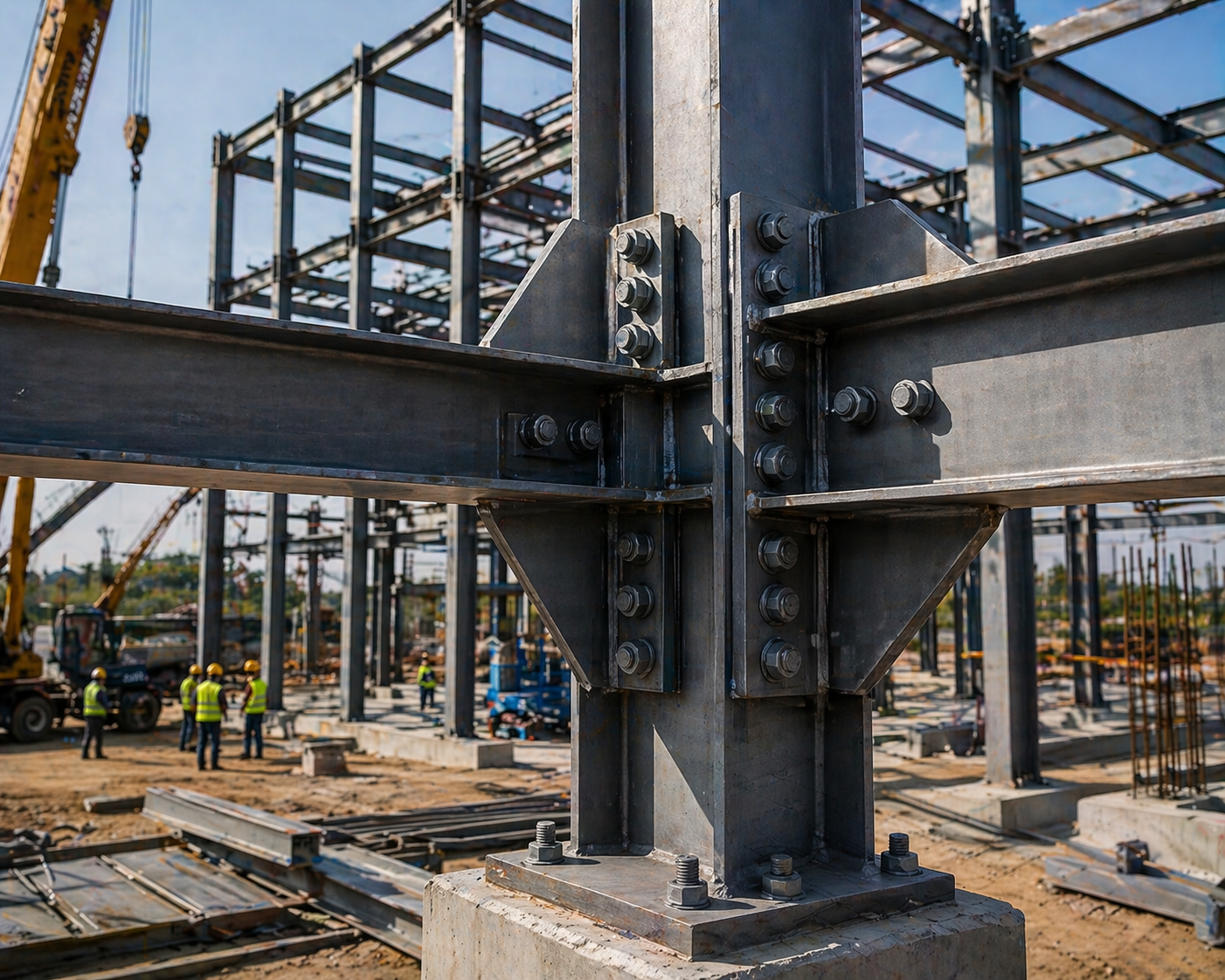
In structural steel construction, the strength of a building lies not just in its members  beams, columns, and braces  but in how those members are connected. Connections transfer loads between elements, resist forces in multiple directions, and must maintain their integrity under both service and extreme loading conditions. A well-designed structure with poorly designed connections is a structure waiting to fail.
Connection design is a specialist activity within structural engineering that requires a detailed understanding of load transfer mechanisms, weld and bolt behaviour, plate geometry, and code requirements. It sits at the intersection of structural analysis and fabrication practicality.
Steel connections are broadly classified by their moment-carrying capacity. Simple or pinned connections transfer shear only and allow rotation  typically used in simple-frame construction where moment is resisted by other elements. Semi-rigid connections transfer partial moment and are designed to specific rotational stiffness. Rigid or moment connections transfer both shear and moment and are used in moment-resisting frame systems where lateral stability relies on joint fixity.
Each connection type has implications for the design of adjacent members, the stiffness of the overall frame, and the complexity  and cost  of fabrication and erection.
--- VHS Engineering Team"Connection design is where structural intent becomes construction reality. Poorly designed joints create risk; well-designed ones build confidence."
In project schedules, connection design is sometimes treated as a drafting task to be completed late in the process. In practice, it requires engineering judgement and code-compliant calculations for every connection type in the structure. Connections must be checked for shear, tension, bearing, block shear, weld strength, and local plate stability  often simultaneously.
Underestimating the engineering effort in connection design leads to late-stage revisions, fabrication delays, and in some cases, on-site modifications that compromise both structural performance and programme delivery.
A connection that is structurally sound but difficult to fabricate or erect creates its own set of problems. Tight bolt spacings that prevent wrench access, weld details that require out-of-position welding, or connection geometries that require precise alignment during erection all increase cost and programme risk. Good connection design accounts for workshop capabilities and site erection sequences, not just the forces in the members.
VHS Engineering's connection design service integrates structural calculation with fabrication awareness. Our connections are designed to perform structurally and to be buildable  reducing workshop cost and site delays without compromising safety margins.
Connection design must comply with the applicable structural steel code  IS 800, AISC 360, AS 4100, or Eurocode 3, depending on the project location. Each code has specific requirements for minimum plate thicknesses, bolt edge distances, weld throat sizes, and joint classification. Connection calculations must be documented clearly and traceable to the design brief and applicable standard.
VHS Engineering produces comprehensive connection design calculations and supporting sketches that form part of the engineering documentation package, enabling review by principal engineers, certifiers, and regulatory bodies.